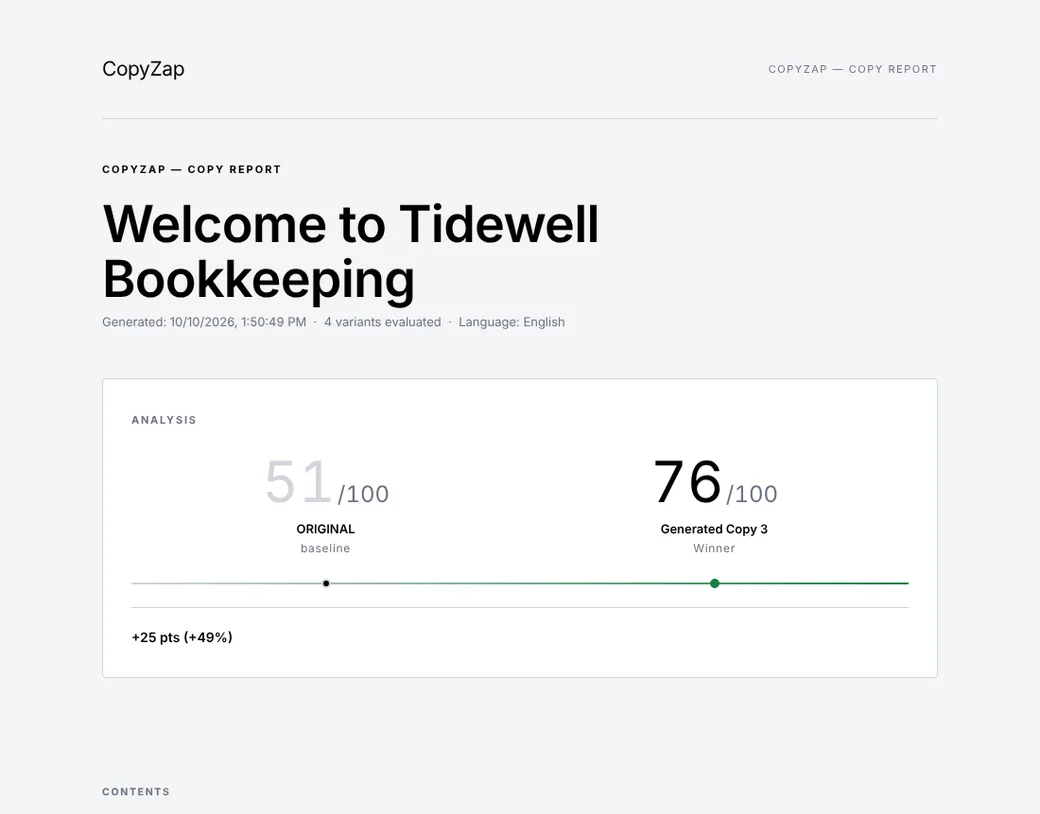
You’ve written three strong versions of a landing page. You attach them to an email, add “Let us know which one you like best,” and hit send.
It feels collaborative. It feels respectful of the client’s opinion. And it quietly hands them the one job they hired you to do: deciding which copy will work.
Why “pick one” backfires
The client picks by taste, not by goal. Faced with three options, most people choose the one that sounds most like them, or the one their boss would like. Neither has much to do with whether it will convert their buyers.
It invites mixing. “Can we take the headline from A, the second paragraph from C, and the ending from B?” Each version was built to work as a whole. A patchwork of the three usually works worse than any one of them.
It adds rounds. Every option is a new thing to discuss. More options mean more opinions, more forwarded emails and more “let me check with the team.”
Behavioral researchers call this choice overload. It’s strongest when people aren’t sure what they’re looking for, which is exactly where most clients are when they judge copy.
It signals that you’re not sure. If the expert can’t choose, why should the client trust the copy at all? Your judgment is part of what they pay for. Leaving it out of the email makes the work look smaller than it is.
What a recommendation looks like
A recommendation still shows the client the alternatives. The difference is that you lead. It has four parts:
- One clear pick. The version you’d publish.
- The reason, tied to their goal. Not “we like it,” but why it should work for their readers.
- The alternatives, as backup. Kept on file, with one line on where each could be useful.
- An easy yes. A next step the client can agree to in one reply.
Here’s the same email, written both ways. The client is a bookkeeping firm launching a new landing page.
Hi Ana,
Attached are three headline options for the new landing page. Let us know which one you prefer!
Hi Ana,
We recommend Version B for the new landing page: “Close your books in 3 days, not 3 weeks.”
Why: your buyers are small-business owners who dread month-end. B names the result they want, in the first line, with a number they can picture. It scored highest of the three on clarity and on fit for that audience.
Version A is warmer but vaguer, so we’d keep it for the About page. Version C works well for returning clients; we suggest it for your next newsletter.
If B works for you, reply “go” and we’ll have it live by Thursday.
The second email is longer, but it’s faster to answer. Ana doesn’t have to judge three headlines. She only has to agree with one reasoned choice, or push back on it, which is a much better conversation to have.
A simple way to choose before you recommend
A recommendation is only as good as the choice behind it. Before you send anything, run every version through the same three steps.
- Write the goal in one sentence. For example: “Get small-business owners to book a free call.” If you can’t write it, you’re not ready to compare versions.
- Judge every version on the same criteria. Four work for most copy:
- Clarity: is the message understood at once, without jargon?
- Persuasion: does it move the reader toward the goal?
- Audience fit: does it speak to the people who will read it?
- Structure: does it flow in a sensible order?
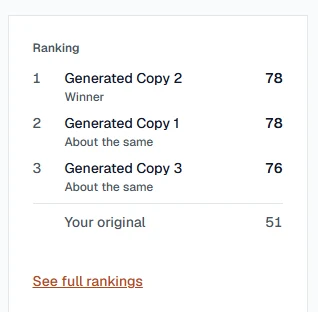
- Be honest about close calls. If two versions are nearly tied, say so: “A and B are about equally strong; we picked B because it’s shorter for mobile.” Don’t present a tiny difference as a big win. Clients notice, and your next recommendation counts for less.
What changes when you work this way
The conversation moves from taste to goals. Instead of “I don’t love that word,” you hear “Does this work for first-time buyers?” That’s a question you can answer.
Approvals get simpler, because there’s one thing to approve. And over time the client starts to treat you as the person who knows which copy works, not as the person who supplies options.
Where CopyZap fits
CopyZap was built for exactly this step. Paste your copy or a page URL, and it writes three new versions and scores each one, and your original, from 0 to 100 on clarity, persuasion, audience fit and structure. It shows you the best version and how far it’s ahead. When versions land within 3 points of each other, it tells you they score about the same, so you never oversell a tie. (How the score works.)
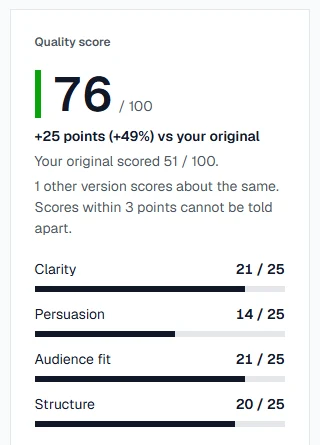
When you’re ready, export the report and send it to your client: the recommendation and the reasons, already written down.