
“Why would I pay for CopyZap when I already have ChatGPT?”
It’s a fair question, and we hear it a lot. Ask ChatGPT, Claude or Grok to improve your client’s homepage and you get a new version in seconds. It usually reads better than the original.
But writing a new version isn’t the hard part anymore. The hard part is everything that comes after it. Is the new version actually better? By how much? Which of several versions is best? Did it invent a fact along the way? And how do you show the client why?
That’s the difference this post is about. A chat assistant gives you text. CopyZap gives you better copy and the proof that it is better: three versions, each scored against your original, and a winner you can defend. You can try to rebuild that in a chat, and below we show exactly what it takes.
What happens inside one run
You paste your copy and click a button. Behind that button, CopyZap runs a long chain of steps, and each step checks the one before it. This is the part you don’t see, and it’s the part that makes the result better.
Before anything is written
- It reads your copy, pasted or fetched from a live page. It works out the kind of text (web page, email, ad, post or short text) and shows you what it understood, so you can correct it.
- You decide what may change. Each part is set to Improve, Keep as is or Leave out. A testimonial or legal line you keep is never touched.
- It looks for what’s missing. Based on the goal and the kind of text, it finds the facts your copy needs: a price, proof, a first step, what happens after someone gets in touch. Copy that teaches or builds a brand is never asked for a price.
- It asks you, one question at a time. Up to five questions, most useful first. For each one, it first checks your own page for an answer hidden where it does no work, like a figure inside a testimonial.
- It reads every answer. It turns each one into a short fact, asks once to clarify when an answer is vague (“50% of what?”), and skips questions your answer already covered.
- It guards your facts. A number you never typed is dropped. A currency you never named is taken out. “About 120” never becomes “more than 120”.
Writing
- It writes three new versions, with your facts in them from the start. A web page gets a new page, not a polish: CopyZap may open it differently, put the strongest reasons first and end with one clear call to action. An email keeps its subject line, greeting and sign-off; an ad keeps its lines.
- It checks each version for invented facts. Before scoring, every number or quoted phrase that isn’t in your original or your facts is found and taken out when possible.
Scoring
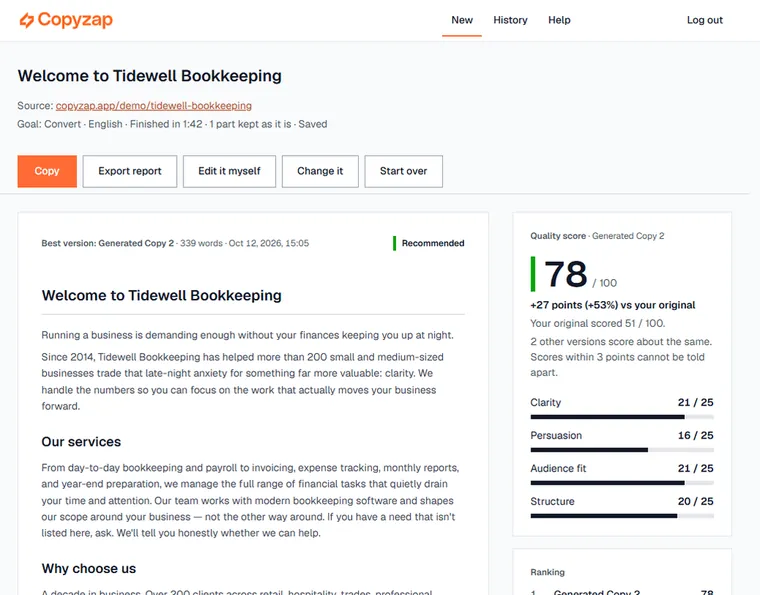
- It scores your original and all three versions on the same scale: Clarity, Persuasion, Audience fit and Structure, 25 points each, 100 in all.
- It throws out broken readings. A score that comes back with a part missing or at 0 doesn’t count. That version is read again.
- It scores close calls three times. Any version within 3 points of another, or of your original, is scored three times, and the middle score counts. One unusually high or low reading can’t decide the winner.
- It ranks, explains and warns. It names the winner, marks versions that score about the same, explains each of the four parts in plain words, and lists the claims you should still verify before publishing.
After the run
- It tells you what’s still missing. If you skipped the questions, it names the facts your copy lacks and its weakest score part, and can write three new versions with your answers, showing both runs side by side.
- Every change you ask for is scored too. CopyZap rewrites once, scores the result and keeps whichever version is better.
That’s why a run takes about two minutes for a short page and about four for a long one. And it’s why a slogan costs about as much as a short email: every run writes three versions and scores them all, with close scores read three times.
In a chat, you get step 7, once. Every other step is yours to build, as the next section shows.
What it takes to do the same in ChatGPT
Let’s take one real job: improve a client’s homepage and send them a recommendation. Here is what you would need to do in ChatGPT, Claude or Grok to get the same result. It works the same way in all three.
1. Write the brief
Tell the chat the goal, the audience, the tone and the kind of text. Then list the parts that must not change, such as a legal line or a client testimonial, and paste them so it knows which ones you mean.
In CopyZap: it reads the page and shows what it understood. You set each part to Improve, Keep as is or Leave out with one click.
2. Write the rules against invented facts
Ask it to keep every price, name and number, and not to add claims, figures or quotes. Then check each version yourself, line by line, because a chat can still slip in “over 200 happy clients” or turn “about 120” into “more than 120”.
In CopyZap: it is told not to invent, checks every version for numbers and quoted words that aren’t in your original or your facts, takes them out, and lists the claims you should still verify before publishing.
3. Ask for three different versions
One version gives you nothing to compare. Ask for three, and ask for them to be really different, not three rewordings of the same idea.
In CopyZap: every run writes three versions.
4. Write a scoring rubric
To compare versions you need a yardstick. Write one: what counts as clear, persuasive, right for the audience and well structured, and how many points each is worth. Ask it to score your original too, on the same scale, or you won’t know how far you came.
In CopyZap: the four parts and the 0 to 100 scale are built in, and your original is always scored next to the new versions.
5. Score in a fresh chat
The chat that wrote the versions is now grading its own homework. Open a new chat, paste the rubric, the original and the three versions, and ask for scores and reasons.
In CopyZap: scoring is its own step, with the same rubric every time.
6. Score the close calls again
Ask for the same scores twice and they will often move a few points. When two versions are close, that wobble can decide the winner. So score the close ones three times and take the middle score. Then decide how big a gap counts as a real difference.
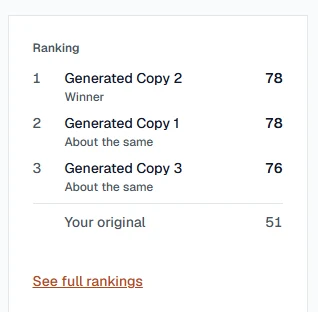
In CopyZap: any version within 3 points of another is scored three times and the middle score counts. Versions that stay within 3 points are marked “about the same”, so a tiny gap is never sold as a win.
7. Find the missing facts, and write again
Ask what the copy is missing to persuade, answer the questions, and then have it write three new versions with those facts from the start. Then score everything again (steps 4 to 6).
Patching the facts into the winner is tempting, but in our tests it didn’t raise the score. Writing three new versions with the facts did.
In CopyZap: Make it stronger asks up to five short questions, shows you when your page already holds an answer, and keeps your numbers exactly as you typed them. After the run, Answer and run again writes three new versions and shows both scores, for example “Last run: best 76 → this run: best 78”.
8. Perfect the winner
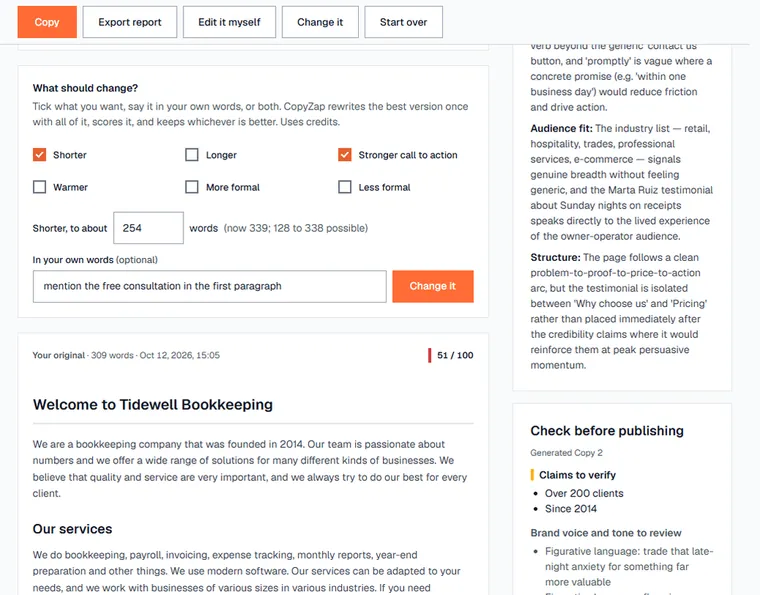
Ask for it shorter, warmer or with a stronger call to action. Then score the new version (steps 5 and 6 again), compare it with the old one and keep the better one. Sometimes the “improved” version scores lower.
In CopyZap: tick what should change, add a request in your own words, or both. It rewrites once, scores the result and keeps whichever is better, so asking for a change never makes your result worse. You can also edit the text yourself and get a fresh score for your edit.
9. Build the report
Copy the original, the versions, the scores and the reasons into a document. Make a table, add your logo, and write a short summary the client can read.
In CopyZap: Export report gives you a before-and-after report with all versions, scores, reasons and the facts you added. With any credit pack it carries your logo and company name.
10. Save it, and do it the same way next time
Keep your prompts and your rubric somewhere safe. Use exactly the same ones for the next client, or this month’s 78 means something different from last month’s 78.
In CopyZap: every run is saved in History, and every run, in each of the six languages, is scored on the same scale.
Count it up
Done by hand, one homepage means a long brief, several chats, the same texts pasted again and again, a line-by-line fact check and a report built by hand. And every time the client changes a line, you score everything again.
In CopyZap it’s one run: about two minutes for a short page, about four for a long one, plus a few short questions if you choose to answer them.
Better copy, and you can prove it
Easier is nice. Better is what your client pays for. Here is why the copy that comes out of CopyZap is stronger than a single rewrite from a chat, and how you show it.
Why the result is better
- The best of three, not the first try. Every run writes three versions and recommends the one that scores highest. A chat gives you one version, and you take it on trust.
- Real facts instead of filler. Make it stronger asks for your price, your proof and your next step. Real facts mostly lift Persuasion, the part of the score where most copy has the most room to grow.
- Nothing invented. Numbers you never gave are dropped, and “about 120” never becomes “more than 120”. The copy stays true and safe to publish.
- Every change has to earn its place. A change is kept only when it scores better, so the result never gets worse.
How you prove it
- The score against the original. Your original is scored on the same scale as the new versions. In our demo run for Tidewell Bookkeeping, the original scored 51 and the best version 78: 27 points ahead.
- The reasons, in plain words. For each of the four parts, CopyZap explains what works and what still holds the copy back.
- A second opinion from outside. Check with another AI sends the result to ChatGPT, Claude or Grok. It scores the copy itself and says where it agrees. You don’t have to take our word for it.
- A report the client keeps. The before-and-after report shows every version, every score and every reason, with your logo on it if you have a credit pack. See the sample report.
Try the test yourself
Ask ChatGPT, Claude or Grok to improve your homepage. Then run two things in CopyZap: your original page, and the chat’s version. CopyZap scores whatever you paste in as the original, so you see both on the same scale, next to the three versions CopyZap writes. Same yardstick, your own copy, your own numbers.
When a chat is enough
Chat assistants are great for brainstorming and for a first draft from a blank page; CopyZap improves copy you already have. But once the copy matters and a client will ask “why this one?”, you need more than text. You need the best version, and the proof.
You don’t have to choose
CopyZap works well with the chat you already use. With Check with another AI, you can send any result to ChatGPT, Claude or Grok. It scores the copy itself and says where it agrees, so you get a second opinion without rebuilding the whole process.
For how to present the winner to a client, see Stop sending clients “here are 3 options”. To see a whole run, read Reading the score or watch the 48-second demo.