
Every client asks the same question when you send new copy: is this better than what we have? Until now, CopyZap answered with a score. A score tells you how good copy is in general. It doesn’t always tell you whether the new version beats the page your client already has.
So every result now opens with a plain answer to that question. And every version now does one more thing a buyer needs: it tells the reader what happens next, without making up the facts to do it.
A side-by-side verdict, read in both orders
CopyZap now reads your original and the new version together, with your facts, and asks which one serves your reader better. It reads them twice, once in each order, so neither text wins just for coming first. The score card then leads with one of four answers:
- Much better than your original
- Clearly better than your original
- About the same as your original, with “No clear gain over your original: keeping your original is fine.”
- Your original reads better, with “Keep your original, and take from this version only the parts you like.”
The score follows in one line, for example “Score: 50 → 78 (+28 points) · Weak → Strong”.
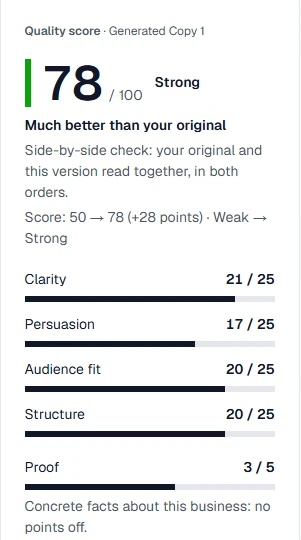
Two rules keep the verdict honest. While the new version still has claims you haven’t checked, it never says more than “Clearly better”: unchecked claims are a reason to hold back. And when the score and the verdict point different ways, the card says why, and tells you to go by the side-by-side check.
Why add it? In our tests a score alone sometimes called a generic rewrite “about the same”, and rated a Spanish version that switched from usted to tú far too high. Reading the two texts together caught both, and gave the same verdict in either order almost every time.
Help for the buyer, with blanks instead of guesses
We compared CopyZap with ChatGPT on live websites. Copywriters preferred CopyZap’s writing. Buyers often preferred ChatGPT’s, for a simple reason: it told them who the page was for, what happens next, and answered their questions. It did that by inventing facts: response times, guarantees, prices.
Now CopyZap adds the same help, without the inventing. Where a version doesn’t have it yet, it adds:
- who the page is for, said plainly near the top;
- what happens after someone gets in touch;
- a short FAQ with the questions a buyer would really ask;
- the call to action after each main section, not only at the end.
It uses only your facts. When the buyer needs one your page doesn’t give, the copy gets a blank, such as [✱ your usual response time]. A promise your page doesn’t make, even a soft one like “no commitment”, gets its own sentence ending in ✱. Absolute claims like “the only” stay only as far as your page proves them.
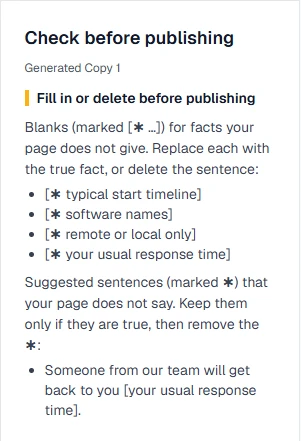
All of them are listed under Fill in or delete before publishing. Replace each blank with the true fact or delete the sentence. It takes a minute, and the page your client publishes says nothing they can’t stand behind.
Generic copy now costs points
The score card has a new line, Proof, from 1 to 5: how concrete the copy is about this business. Named services, numbers, client results, prices and a guarantee count. “Quality”, “professional” and “tailored to you” don’t. Copy any competitor could publish loses 12 points at 1 of 5 and 6 points at 2 of 5. From 3 up, nothing comes off.
On our demo page
We ran our demo page, Tidewell Bookkeeping, on November 12, 2026: 309 words, goal Convert, one version, no extra facts.
| Verdict | Much better than your original |
|---|---|
| Score | 50 → 78 (+28 points), Weak → Strong |
| Proof | 3 / 5, no points off |
| Added for the buyer | “This is for you if…”, a four-step “How it works”, six FAQ questions |
| To fill in or delete | 4 blanks (start timeline, software names, remote or local, response time) and 1 suggested sentence |
| Time and credits | 2:07, 30 credits (the estimate said about 60) |
The new version kept the founding year, the 200 businesses, the $290 starting price and the testimonial word for word. Every fact it didn’t have is a blank you can see.
One version or three
One version is the default: about 60 credits for a short text and 70 for a page of up to 1,000 words. Three versions to compare cost about twice as much on a page, and in our tests the best of three scored only about 3 points more. Every version gets the side-by-side check and the help for the buyer either way. See Reading the score for every detail.